Can AI Actually Help My Business? A Practical Test
Can AI Actually Help My Business? A Practical Test
Yes—but not because “AI” is automatically useful.
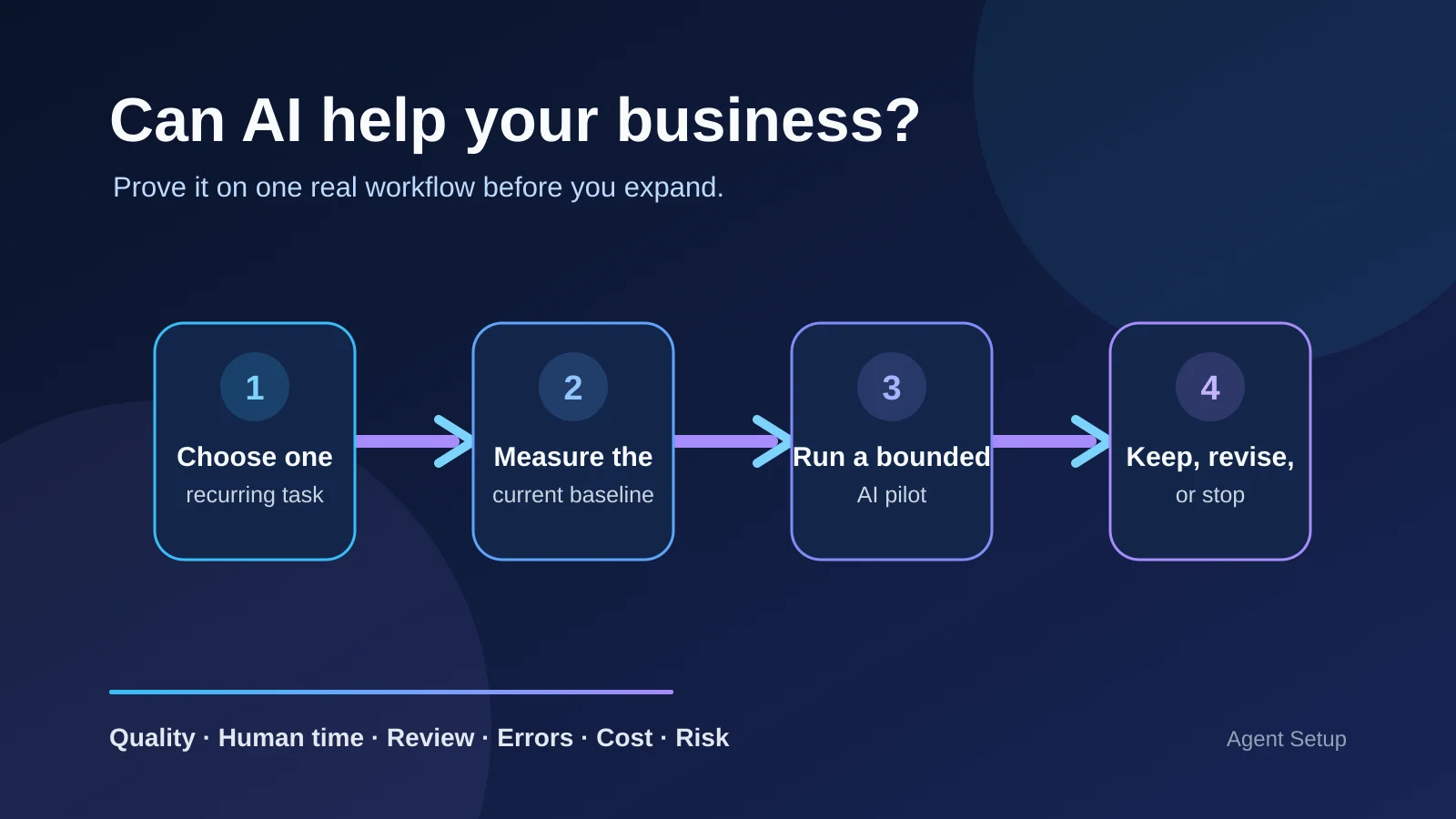
AI can help when it performs a specific recurring task well enough to improve the business after you count human review, corrections, direct costs, and the consequences of mistakes. The reliable way to find out is to test one workflow against the way you do it today.
Do not start by buying a broad transformation. Start with one small proof.
The short answer
Use this seven-step test:
- Choose one frequent, measurable workflow.
- Record the current time, quality, and error baseline.
- Give AI only the access and authority that pilot needs.
- Test normal examples and difficult edge cases.
- Count review, editing, rework, and direct costs—not just generation speed.
- Decide in advance what result means keep, revise, or stop.
- Expand only after the evidence supports it.
This is the approach Agent Setup uses before widening an AI employee’s tools, data access, or ability to act without approval.
What the evidence actually shows
AI has created measurable gains in real workplaces, but the results are not uniform.
In a field study of 5,179 customer-support agents, access to a generative-AI assistant increased issues resolved per hour by 14% on average. Gains were much larger for novice and lower-skilled workers—34%—and minimal for experienced, highly skilled workers in that setting.1
A separate experiment involving more than 700 consultants found a similar boundary. On tasks inside GPT-4’s tested capabilities, AI improved performance by roughly 40%. On a task designed outside that boundary, performance declined.2
Those studies do not promise a particular return for your company. They show why the answer depends on the task, the worker, the examples, and the way the system is introduced.
AI use is already widespread. Nationally representative surveys found that by late 2024, 23% of employed U.S. respondents had used generative AI for work in the previous week. Respondents reported time savings equivalent to 1.4% of total work hours.3 But adoption and reported time savings are not the same as proven business value. Your result still needs a local baseline.
Which business task should you test first?
The best first workflow is usually repetitive enough to measure, valuable enough to matter, and safe enough that a mistake is easy to catch and reverse.
Good candidates often include:
- sorting or classifying incoming requests;
- preparing a first draft from approved source material;
- summarizing meetings into a fixed template;
- turning notes into tasks for human review;
- drafting replies to common customer questions;
- checking documents for missing fields;
- creating a daily or weekly operational report;
- researching a defined question with source links.
The U.S. Small Business Administration similarly recommends starting small and testing whether AI adds value. Its examples include repeat tasks, email sorting, list updates, meeting summaries, reusable templates, content support, and common customer-service work.4
A weak first pilot is “help with marketing” or “automate operations.” Those are not workflows. They are departments.
A stronger pilot is “draft replies to our 20 most common support questions using the approved policy library, with a person reviewing every reply before it is sent.” That has an input, an output, a reviewer, and a measurable result. Once you have chosen the workflow, the one-job setup method explains how to teach it, test it in a fresh context, and make it repeatable.
Run a one-workflow proof test
1. Write down the current process
Before introducing AI, sample the workflow as it works today.
For at least 10 to 30 representative cases, record:
- total elapsed human time;
- output quality or completion rate;
- number and severity of errors;
- rework required;
- direct software or labor cost;
- customer or operational consequence when something goes wrong.
Without this baseline, a faster-looking demo can be mistaken for an improvement.
2. Define the job and the boundary
Write a short task contract:
- What input may the AI use?
- What output must it produce?
- Which sources or rules control the answer?
- What must it never infer or do?
- Who reviews the result?
- Which external actions still require approval?
For a first pilot, let the AI prepare, classify, summarize, or draft while a person retains approval over consequential external actions. Low-consequence, reversible work can receive more freedom sooner than payments, legal commitments, account changes, customer promises, or deletion.
If the pilot needs broad mailbox access, production credentials, or permission to send messages just to demonstrate basic usefulness, narrow the workflow.
3. Test normal and difficult examples
Do not test only the clean cases used in a demo.
Include:
- incomplete inputs;
- unusual customers or requests;
- conflicting source material;
- an outdated document;
- a case that should be escalated;
- a case where the correct action is to refuse or ask for more information.
The MIT consultant experiment is a useful warning: strong performance on one class of tasks does not prove the system will recognize when it has crossed into a task it handles poorly.2
4. Measure the whole workflow
Count the benefit after review, not before it.
A practical pilot scorecard includes:
- Task success: Was the required job completed correctly?
- Quality: Did the result meet the same standard as the current process?
- Human time: How much operator time did the full workflow require?
- Review time: How long did checking and editing take?
- Errors and rework: How often did the result create extra work?
- Direct cost: What did the model, software, setup, and maintenance cost?
- Failure consequence: What is the realistic impact of a bad result?
NIST’s AI Risk Management Framework Playbook emphasizes that measurement should reflect the purpose and context of the system, and recommends fit-for-purpose tests, acceptable performance limits, and pre- versus post-deployment comparison.5
“What should be measured depends on the purpose, audience, and needs of the evaluations.”
— NIST AI RMF Playbook, Measure 1.15
This scorecard is a practical synthesis of that guidance and the workplace studies above. It is not an official NIST or SBA formula.
Decide before the pilot what success means
Set the decision rule before you see the result.
Keep
Keep the workflow when it meets the quality requirement, saves meaningful net time or cost, stays inside the acceptable error limit, and does not create disproportionate risk.
Revise
Revise it when the task is promising but the instructions, source material, review step, tool access, or task boundary are wrong.
Common revisions include:
- limiting the task to fewer request types;
- replacing open-ended generation with a fixed template;
- improving the approved source library;
- adding a required escalation rule;
- separating one complicated workflow into two simpler ones;
- removing an unnecessary tool or permission.
Stop
Stop when review and correction erase the time saved, quality remains below the required standard, edge cases cannot be detected reliably, direct cost outweighs the benefit, or a plausible failure has unacceptable consequences.
Stopping a weak pilot is a useful result. It prevents a demo from becoming an expensive operating dependency.
How much authority should the AI get?
Treat authority as a ladder:
- Suggest: produce options or a draft.
- Prepare: assemble the exact proposed action for review.
- Act with approval: execute only after a person approves the specific action.
- Act within limits: perform a narrow, reversible action autonomously inside explicit constraints.
- Escalate: stop and hand the case to a person when a condition is uncertain or high consequence.
Move upward only when measured performance supports the change.
SBA guidance recommends human review and highlights intellectual-property, security, customer-trust, and ethical concerns. NIST’s Generative AI Profile similarly frames generative-AI use as something organizations should evaluate for trustworthiness and risk, not only output speed.46
For implementation controls, see the AI agent security checklist and the tool rollout order.
When AI may not be worth it
AI may be a poor fit when:
- the task happens too rarely to repay setup and maintenance;
- the source information is missing, unreliable, or constantly changing;
- correctness cannot be checked at a reasonable cost;
- each case requires unique professional judgment;
- a mistake would create an unacceptable legal, financial, safety, or customer consequence;
- a conventional rule, template, integration, or script solves the problem more reliably;
- no one owns the workflow after launch.
Sometimes the right answer is better documentation, a simpler process, or ordinary automation—not AI.
Recheck after the workflow changes
A passing pilot is not permanent proof.
Recheck the workflow after meaningful changes to:
- the model or provider;
- prompts or instructions;
- connected tools;
- source documents or business rules;
- the people using or reviewing it;
- the kinds of cases entering the workflow;
- the authority granted to the system.
NIST recommends reassessing metrics and controls over the system lifecycle because operating conditions, models, and failure patterns change.5
The practical conclusion
AI can help your business when it improves a defined workflow after all costs and risks are counted. The proof is not a clever conversation or a fast draft. The proof is a better measured process.
Choose one task. Keep the first authority boundary narrow. Compare it with your real baseline. Then keep, revise, or stop based on evidence.
If you want help choosing that workflow and setting the authority and measurement boundaries, Agent Setup can build the pilot with you. Start with the private AI agent setup guide or contact us to scope a one-workflow proof.
Footnotes
-
Erik Brynjolfsson, Danielle Li, and Lindsey R. Raymond, “Generative AI at Work,” NBER Working Paper 31161, revised November 2023. https://www.nber.org/papers/w31161 ↩
-
Meredith Somers, “How generative AI can boost highly skilled workers’ productivity,” MIT Sloan, October 19, 2023, summarizing Dell’Acqua et al., “Navigating the Jagged Technological Frontier.” https://mitsloan.mit.edu/ideas-made-to-matter/how-generative-ai-can-boost-highly-skilled-workers-productivity ↩ ↩2
-
Alexander Bick, Adam Blandin, and David J. Deming, “The Rapid Adoption of Generative AI,” NBER Working Paper 32966, revised February 2025. https://www.nber.org/papers/w32966 ↩
-
U.S. Small Business Administration, “AI for small business,” last updated February 14, 2025. https://www.sba.gov/business-guide/manage-your-business/ai-small-business ↩ ↩2
-
National Institute of Standards and Technology, “AI RMF Playbook: Measure.” https://airc.nist.gov/airmf-resources/playbook/measure/ ↩ ↩2 ↩3
-
National Institute of Standards and Technology, “Artificial Intelligence Risk Management Framework: Generative Artificial Intelligence Profile,” NIST AI 600-1, published July 26, 2024. https://www.nist.gov/publications/artificial-intelligence-risk-management-framework-generative-artificial-intelligence ↩